
Blog
Precision Femto Laser Machining Case Study for Semiconductor Equipment Applications - Ming-Li Precision
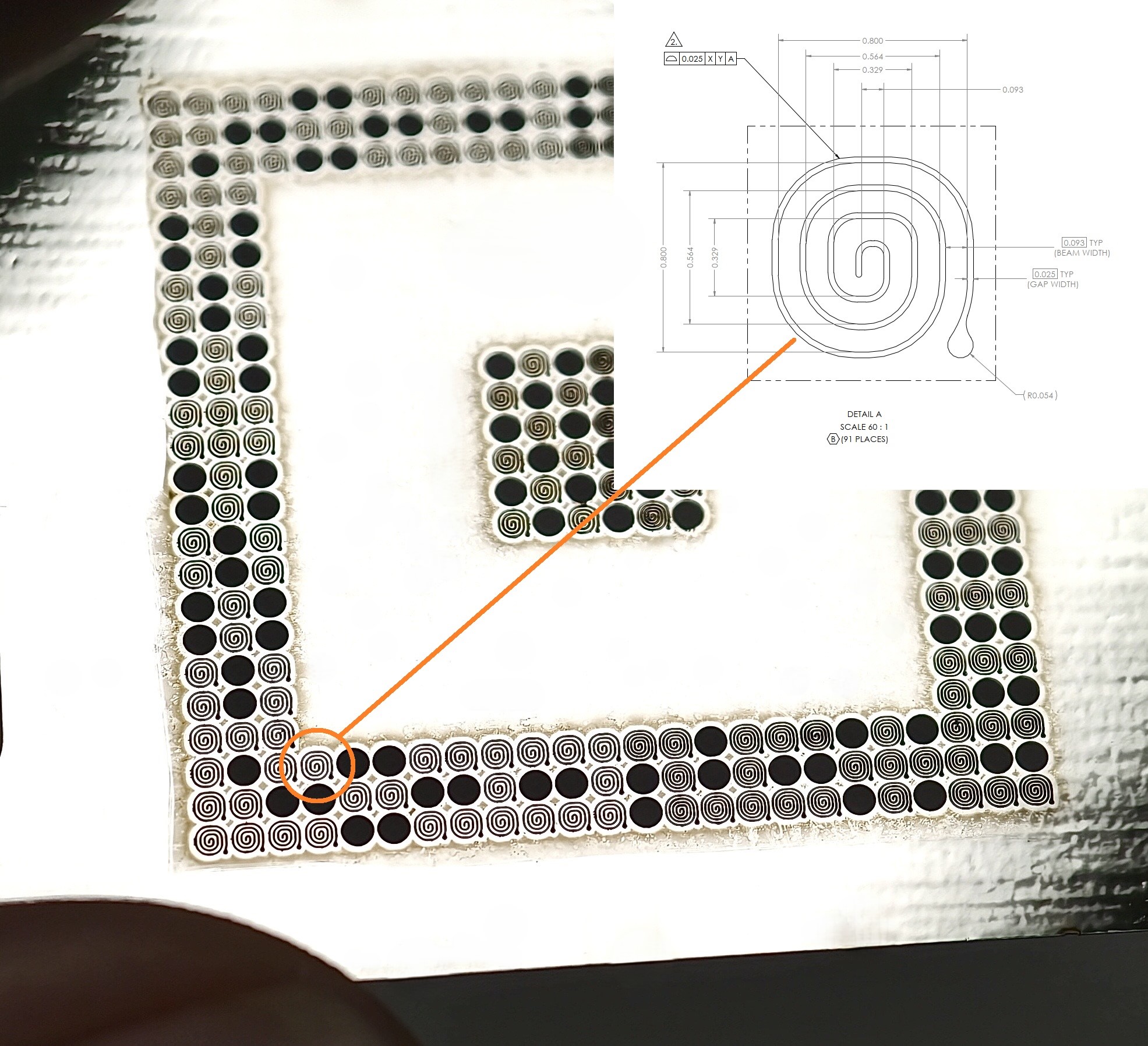
Precision Laser Machining of Ultra-Fine Microstructures on 0.03 mm Metal Foil
A semiconductor equipment case study demonstrating Ming-Li’s femtosecond laser machining capability using DMG MORI LASERTEC 50 Shape Femto for burr-free, high-precision micro feature manufacturing.
Customer Challenge: Precision Laser Machining for Semiconductor Equipment
In semiconductor equipment manufacturing, advanced components increasingly require ultra-fine functional microstructures on extremely thin metallic substrates. For this project, the customer required Precision Laser Machining of repeated spiral microstructures on a metal foil with a thickness of only 0.03 mm.
The component required high dimensional consistency, stable micro-feature geometry, minimal thermal distortion, and burr-free edge quality. Conventional machining methods such as micro milling, EDM, chemical etching, or stamping are often limited when processing such fine geometry on ultra-thin material.
Technical Challenges
0.03 mm Thin Metal Foil
The material thickness was only 0.03 mm. At this thickness, even minor thermal input may cause deformation, discoloration, edge distortion, or dimensional instability.
Ultra-Fine Spiral Geometry
The spiral microstructure required consistent geometry, narrow spacing, and repeatable beam control across a high-density pattern layout.
High Repeatability
The design included repeated microstructures across the component, requiring stable positioning accuracy and consistent feature quality.
Critical Micro Feature Requirements
| Item | Requirement |
|---|---|
| Material Thickness | 0.03 mm |
| Feature Type | Spiral microstructure array |
| Beam Width | 0.093 mm |
| Gap Width | 0.025 mm |
| Application | Semiconductor equipment component |
| Technology | DMG MORI LASERTEC 50 Shape Femto |
Ming-Li Solution: DMG MORI LASERTEC 50 Shape Femto
To meet the customer’s requirements, Ming-Li utilized the DMG MORI LASERTEC 50 Shape Femto, a femtosecond laser machining system designed for ultra-fine, high-precision micro processing.
Compared with conventional nanosecond or picosecond laser processing, femtosecond laser machining removes material through ultra-short pulse ablation. This greatly reduces heat transfer into the workpiece and helps maintain stable micro-feature geometry on thin materials.
Why Femtosecond Laser Machining?
| Capability | Benefit for Precision Laser Machining |
|---|---|
| Minimal Heat-Affected Zone | Reduces thermal distortion and material deformation |
| Burr-Free Micro Features | Improves edge quality and reduces secondary finishing |
| High Beam Control | Supports ultra-fine gaps, narrow line widths, and complex micro geometry |
| No Tool Wear | Maintains repeatability across complex microstructure arrays |
| Flexible Micro Geometry | Ideal for spiral patterns, micro holes, channels, slots, and functional textures |
Precision Laser Machining vs Conventional Laser Processing
For ultra-fine microstructures, laser pulse duration has a significant impact on machining quality. Conventional nanosecond lasers may create larger heat-affected zones, while femtosecond laser machining provides much better control over thermal influence, edge definition, and micro-feature stability.
This makes femtosecond laser technology suitable for Precision Laser Machining applications in semiconductor equipment, medical devices, precision electronics, optical components, and microfluidic devices.
Manufacturing Results
- Burr-free micro feature machining
- Stable spiral microstructure geometry
- Minimal thermal influence on 0.03 mm thin metal foil
- Consistent beam width and gap formation
- Successful validation for semiconductor equipment application
Precision Laser Machining for Semiconductor Applications
Ming-Li provides Precision Laser Machining Services for advanced semiconductor and high-performance industrial applications. Our femtosecond laser machining capability is suitable for:
- Semiconductor equipment components
- Wafer handling related precision parts
- Sensor and electronic micro components
- Thin metal foil laser machining
- Micro holes, micro slots, and micro texture machining
- Precision shielding and functional metal components
Ming-Li Precision Laser Machining Capability
At Ming-Li Precision Steel Molds, we support customers from prototype development to production with advanced Precision Laser Machining, ultra-precision machining, mold engineering, precision molding, and metrology capabilities.
Our DMG MORI LASERTEC 50 Shape Femto enables ultra-fine microstructure fabrication with excellent dimensional control, repeatability, and surface quality.
FAQ: Precision Laser Machining
What is Precision Laser Machining?
Precision Laser Machining is a manufacturing process that uses highly focused laser energy to create fine features, microstructures, holes, slots, and patterns with high dimensional accuracy and minimal mechanical stress.
What is Femtosecond Laser Machining?
Femtosecond Laser Machining uses ultra-short laser pulses to remove material with minimal heat transfer. It is especially suitable for ultra-fine features, thin materials, and applications requiring low thermal distortion.
What materials can be processed by Precision Laser Machining?
Depending on geometry and application requirements, Precision Laser Machining can be used for stainless steel, copper, aluminum, titanium, nickel alloys, thin metal foils, and other high-performance materials.
Why use Precision Laser Machining for semiconductor components?
Semiconductor equipment components often require micro-scale features, clean edges, stable dimensions, and low thermal impact. Precision Laser Machining helps achieve these requirements without tool wear or excessive mechanical stress.
Can Ming-Li support prototype and production orders?
Yes. Ming-Li supports prototype evaluation, process development, precision laser machining, inspection, and production planning based on customer requirements.
Looking for Precision Laser Machining Services?
Contact Ming-Li to discuss your semiconductor, medical, electronics, optical, or microstructure laser machining project.
Contact Us