
Tooling & Mold Engineering
What is the Plastic Injection Mold Manufacturing Process?
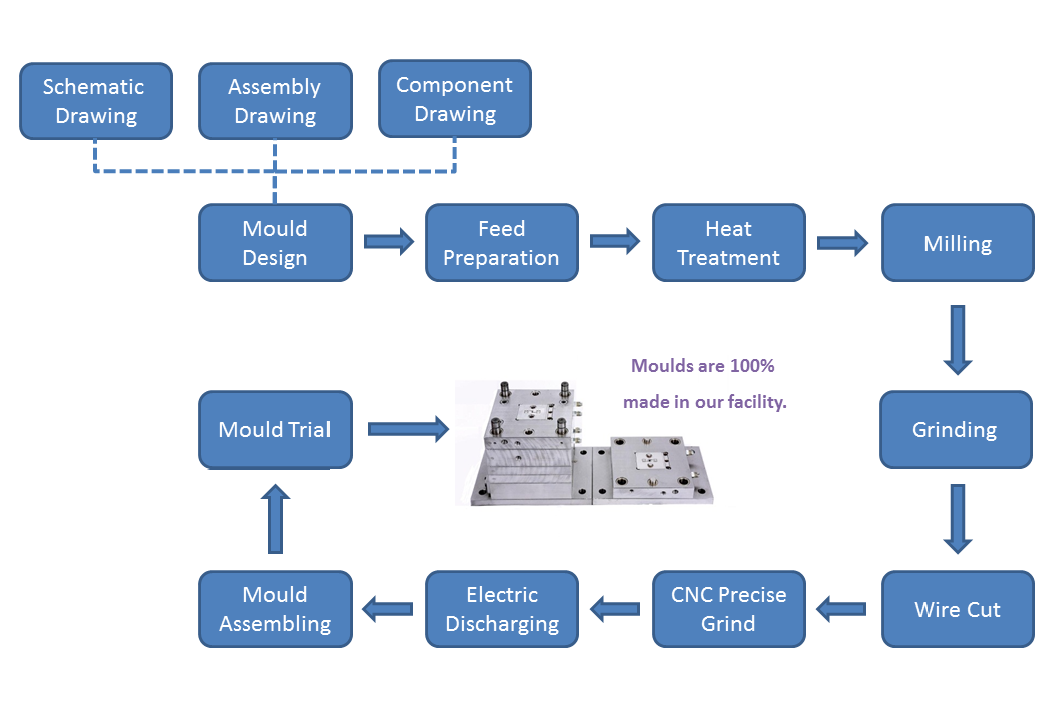
Plastic Injection Mold Manufacturing Process
1️⃣ Requirement Analysis & Product Design
-
Requirement Confirmation
-
Discuss product function, appearance, estimated production volume, material selection, tolerance requirements, surface finish, and budget with the customer.
-
-
3D Product Design
-
Create a 3D model using CAD software (CATIA, UG, SolidWorks).
-
Consider draft angles, wall thickness, sink marks, deformation, and reinforcing ribs.
-
-
Design for Manufacturability (DFM)
-
Analyze potential manufacturing issues: draft angle, wall thickness uniformity, demolding method, gate location, and parting line design.
-
2️⃣ Mold Flow Analysis
-
Use software such as Autodesk Moldflow to simulate:
-
Gate location and runner balance
-
Hot runner vs. cold runner design
-
Potential shrinkage, warpage, and air traps
-
-
Early analysis reduces trial times and production costs.
3️⃣ Mold Design Phase
-
2D/3D Mold Structure Design
-
Select the parting line
-
Determine the ejection system (ejector pins, ejector plate, air ejectors)
-
Design the cooling system (consider advanced systems such as PulseCooling if needed)
-
Choose mold base and steel materials (e.g., P20, NAK80, H13)
-
-
BOM & Process Review
-
Prepare the Bill of Materials and machining workflow
-
Conduct a formal design review before fabrication
-
4️⃣ Mold Fabrication
-
Rough Machining
-
Cut steel blocks → Rough milling → Heat treatment (hardening and tempering).
-
-
Precision CNC Machining
-
Use high-precision CNC milling, EDM (electrical discharge machining), and wire cutting.
-
-
Electrode Fabrication & EDM
-
Manufacture copper/graphite electrodes → Perform EDM finishing on cavities and cores.
-
-
Polishing & Texturing
-
Hand or machine polishing to mirror finish or specified roughness; chemical etching or laser texturing if required.
-
-
Assembly & Fitting
-
Assemble ejector systems, guide pins/bushings, and cooling circuits.
-
5️⃣ Mold Trials and Adjustments (T1 → Tn)
-
First Trial (T1)
-
Conduct the first test shot on an injection machine, check for short shots, flash, sink marks, or warpage.
-
-
Issue Correction
-
Modify gates/runners, improve venting, or polish surfaces as necessary.
-
-
Multiple Trials
-
Repeat testing and adjustments (T2, T3, etc.) until the product meets dimensional, appearance, and stability requirements.
-
6️⃣ Final Approval and Documentation
-
Dimensional Inspection
-
Use CMM, optical projectors, and calipers to verify critical dimensions and shrinkage rates.
-
-
Final Trial (T-final)
-
Perform an extended production run to verify durability and consistency.
-
-
Documentation Delivery
-
Provide trial reports, material certificates, heat-treatment records, cooling layouts, and spare parts lists.
-
-
Shipment or Production Transfer
-
Clean, apply anti-rust protection, pack the mold, and ship or transfer it to production.
-
7️⃣ Mass Production & Maintenance
-
Production Start-Up: Install the mold, establish injection parameters, and begin production.
-
Regular Maintenance: Clean cooling channels, lubricate guide pins/bushings, and check ejector systems for wear.
-
Spare Parts Management: Prepare spare inserts or components for high-wear areas to minimize downtime.
✅ Summary
The plastic injection mold manufacturing process is a comprehensive workflow:
-
Upfront DFM and mold flow analysis prevent costly rework.
-
Precision machining and iterative trials ensure the final product meets quality standards.
-
Proper documentation and ongoing maintenance guarantee long mold life and stable mass production.
Futher FAQ
1. What are the main steps in plastic injection mold manufacturing?
The process includes requirement analysis, product design and DFM review, mold flow analysis, detailed mold design, precision machining and fabrication, multiple mold trials and adjustments, final inspection and documentation, and ongoing maintenance for mass production.
2. How long does it take to build an injection mold?
Lead time varies with complexity and size. Simple molds may take 4–6 weeks, while multi-cavity or precision molds can take 10–16 weeks including design, machining, and trial phases.
3. What materials are commonly used for mold bases and cavities?
Typical materials include P20 tool steel, NAK80, H13 hardened steel, and stainless steel for corrosion resistance. Choice depends on production volume, part material, and surface finish requirements.
4. How does mold flow analysis improve injection molding quality?
Mold flow analysis simulates plastic flow inside the mold, helping engineers identify potential defects such as short shots, warpage, or sink marks before fabrication—saving cost and reducing trial iterations.
5. Can Ming-Li Precision handle high-volume production molds?
Yes. Ming-Li Precision has extensive experience in multi-cavity, high-volume molds for automotive, medical, and electronics OEMs. We provide end-to-end solutions including DFM, machining, testing, and production support.