Blog
Material Selection for Power Module Housings
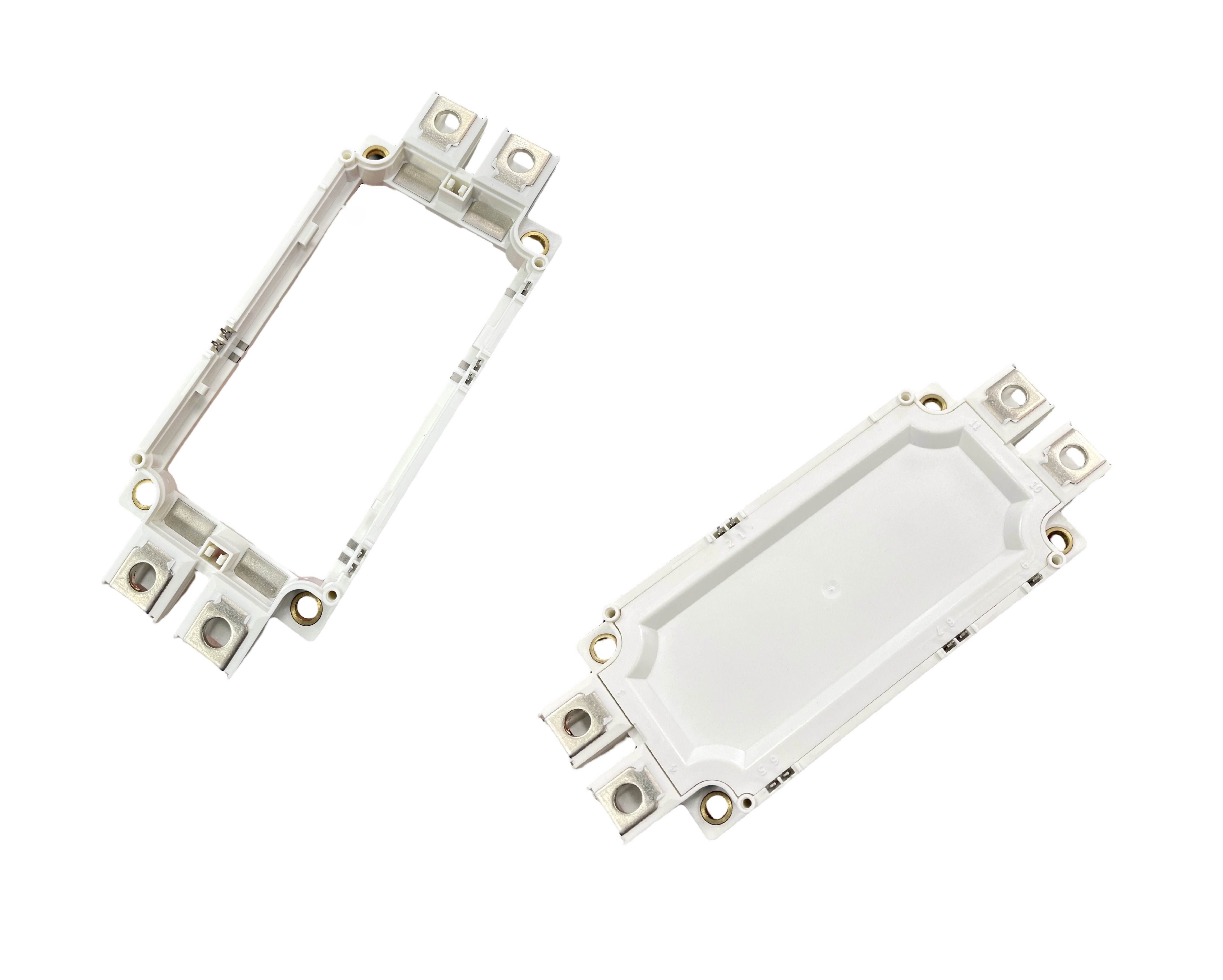
Selecting the proper material for Power Module Housings is one of the most critical decisions in power-electronics design. The housing directly affects thermal stability, insulation reliability, and dimensional precision—factors essential for applications such as EV inverters, industrial servo drives, renewable-energy converters, and power control units.
At Ming-Li Precision, we combine decades of molding experience with engineering analysis to select and optimize materials that meet both performance and manufacturability.
Power Module Housing Materials — Comparison
Concise, side-by-side properties for PBT GF30, PPS GF30, PPS GF40, and PEEK.
| Material | Density (g/cm³) | Continuous Temp (°C) | Key Properties | Typical Applications | Notes |
|---|---|---|---|---|---|
| PBT GF30 | 1.50–1.55 | ≈150 | Good dielectric strength; low moisture; stable dimensions; smooth for insert-molding. | General power-module housings; DC/DC; motor/drive electronics. | UL94 V-0 grades |
| PPS GF30 | 1.63–1.67 | ≈200 | High heat & chemical resistance; low CTE; good creep resistance; insulation stability. | EV inverters near heat sinks; high-density power stages; industrial controllers. | High-temp |
| PPS GF40 | 1.68–1.72 | ≈200 (ST ≈220) | Higher stiffness & flatness vs GF30; reduced warpage; robust through thermal cycling (–40↔150 °C). | Large/thin-wall housings; multi-cavity IGBT; traction inverters. | Tier-1 pick |
| PEEK | 1.30–1.32 | ≈250 (ST >300) | Exceptional strength & fatigue; high purity/low outgassing; stable dielectric at elevated temp. | High-power-density modules; aerospace/defense; premium EV systems. | Premium |
| PA9T / LCP* | 1.25–1.40 | ≈180–230 | Excellent thin-wall flow; low moisture; good dimensional accuracy. | Lightweight control housings; sensors; precision connectors. | *select grades |
ST = short-term. Actual performance depends on the specific grade, fillers, flame rating (e.g., UL94 V-0), process parameters, and geometry.
1. PBT GF30 — The Industry Workhorse
Polybutylene Terephthalate (PBT) with 30% glass fiber reinforcement is the most common choice for Power Module Housings due to its balance of mechanical strength, electrical insulation, and cost efficiency.
Key Advantages:
-
Heat-deflection temperature (HDT): up to 150 °C
-
Excellent dielectric and tracking resistance
-
Low moisture absorption, high dimensional stability
-
Compatible with insert-molding of terminals and busbars
-
UL94 V-0 flame-retardant grades available
Applications: Automotive power modules, DC/DC converters, and general industrial electronics housings.
2. PPS + 30 % GF — High-Temperature Reliability
Polyphenylene Sulfide (PPS) with 30% glass fiber is ideal for higher-temperature or chemically aggressive environments.
It maintains mechanical and electrical stability even under continuous exposure to 180–200 °C.
Key Advantages:
-
Continuous-use temperature: 200 °C
-
Excellent chemical and coolant resistance
-
Very low coefficient of thermal expansion (CTE)
-
Good creep resistance for high clamp-force assemblies
Applications: EV inverters near heat sinks, high-density power stages, or long-life industrial controllers.
3. PPS + 40 % GF — Enhanced Rigidity and Dimensional Stability
For even greater mechanical rigidity, PPS reinforced with 40% glass fiber is increasingly adopted by Tier-1 module makers.
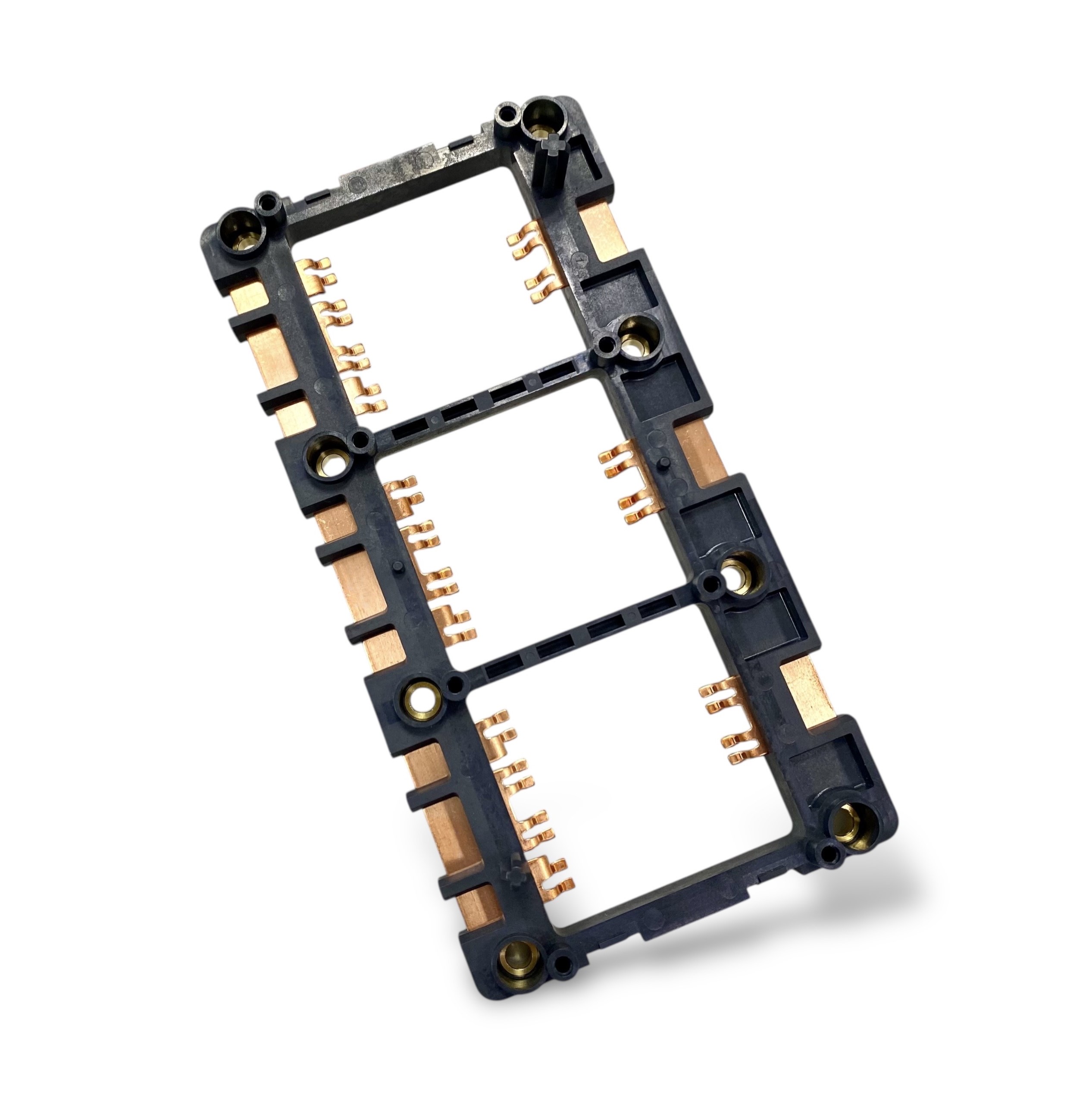
This formulation provides superior stiffness and reduced warpage, especially for large or thin-wall housings that integrate multiple busbars or terminals.
Key Advantages:
-
Higher flexural modulus and tensile strength than PPS GF30
-
Improved flatness and dimensional control under molding pressure
-
Better resistance to deformation during reflow, soldering, or potting
-
Maintains insulation and mechanical integrity after thermal cycling (–40 °C ↔ 150 °C)
Applications: Large EV traction inverter housings, multi-cavity IGBT modules, or structures requiring minimal post-mold shrinkage.
4. PEEK — The Premium High-Performance Choice
Polyether Ether Ketone (PEEK) represents the top tier for extreme environments.
While costlier, it offers unmatched performance for high-power, high-density applications.
Key Advantages:
-
Continuous use temperature up to 250 °C, short-term up to 300 °C
-
Excellent mechanical strength and fatigue resistance
-
Stable dielectric properties under high voltage and humidity
-
Chemically inert, suitable for clean or vacuum environments
Applications: Aerospace, defense, or ultra-high-reliability EV power modules.
5. Emerging Materials and Hybrid Compounds
Advanced materials such as PA9T, LCP (Liquid Crystal Polymer), and thermally conductive PPS/PBT blends are gaining traction for designs requiring higher heat transfer or reduced thickness while maintaining insulation.
When selecting materials, engineers must balance:
-
Continuous service temperature and thermal conductivity
-
Dielectric strength and insulation resistance
-
CTE matching with copper or aluminum inserts
-
Resistance to potting compounds, fluxes, and coolants
-
Processability in high-precision insert molding
Ming-Li’s Material Engineering Expertise
At Ming-Li Precision, we perform Moldflow and FEA simulation to predict shrinkage, warpage, and fiber-orientation effects for each material grade.
Our team collaborates with leading suppliers — Toray, SABIC, Sumitomo, Victrex — to select UL-approved materials that meet automotive and industrial standards (UL94 V-0, IATF 16949, RoHS, REACH).
Our mission: deliver Power Module Housings that combine mechanical precision, thermal reliability, and long-term electrical insulation.
Ming-Li Precision — Redefining Excellence in Power Module Housing Materials and Manufacturing.
Contact: karl@mingli-molds.com.tw
Website: www.mingliprecision.com