
Blog
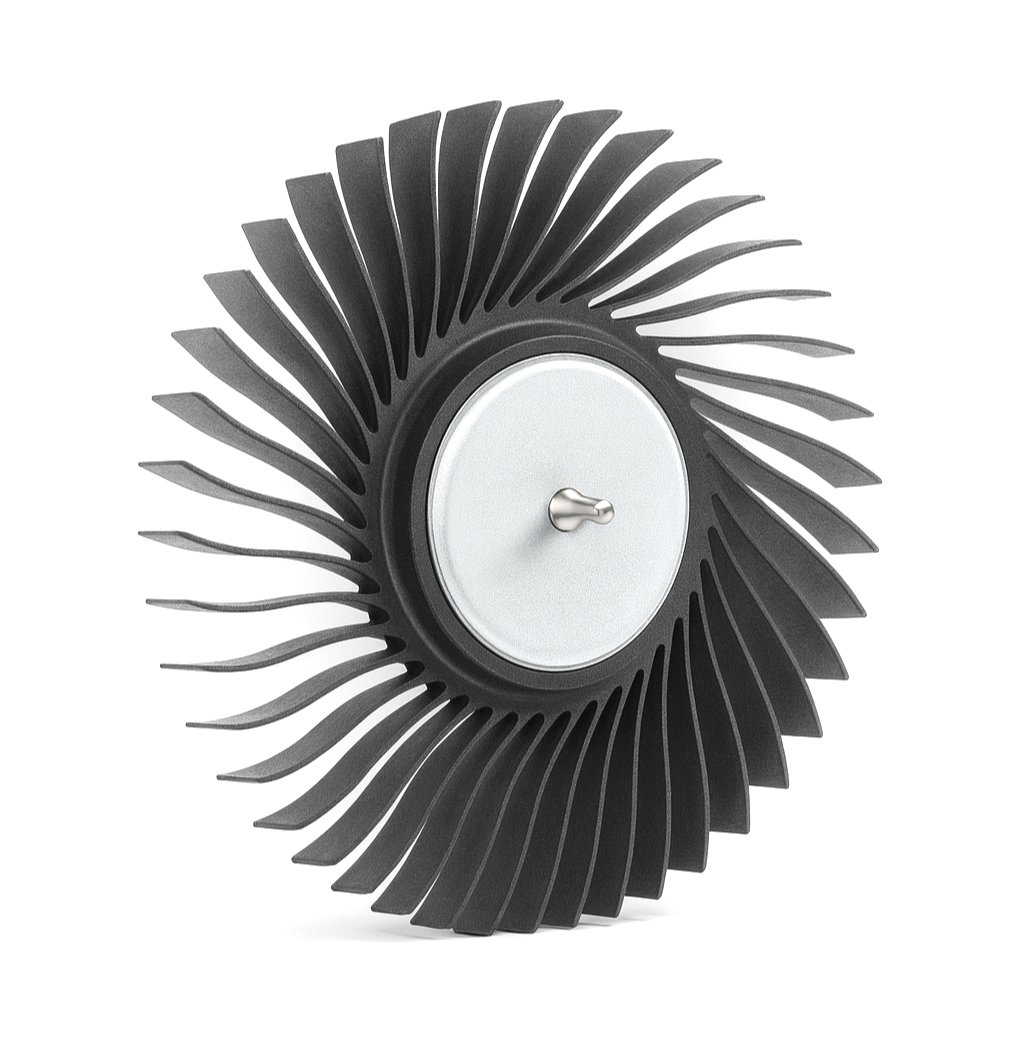
High-Speed PEEK Cooling Fans for Thermal Module Applications Precision Injection-Molding Solutions by Ming-Li Precision
Executive summary
Polyetheretherketone (PEEK) enables a new generation of high-speed, thin-profile cooling fans that operate reliably under elevated temperature, aggressive duty cycles, and compact packaging constraints found in laptops, smartphones, and server/data-center thermal modules. Compared with common engineering plastics (PPS, PA66, PC/ABS), PEEK delivers superior stiffness-to-weight ratio, high glass-transition and continuous-use temperature, excellent fatigue/creep performance, and chemical resistance—all critical to high-RPM stability and long-term dimensional accuracy.
Ming-Li Precision provides end-to-end PEEK fan solutions: ultra-precision mold design and manufacturing (±1 µm machine capability), high-temperature injection molding up to ~420 °C melt, dynamic balancing, warpage control, and ZEISS METROTOM 6 CT for internal-feature and wall-thickness verification—backed by IATF 16949 quality systems and 100+ tons of PEEK molding experience.
Why PEEK for high-speed cooling fans?
High-speed fans—axial or centrifugal impellers—place simultaneous demands on the material and process:
- High RPM stability & safety: blades see large centrifugal stresses; imbalanced mass causes vibration, noise, bearing wear, and potential failure.
- Thermal endurance: notebook hotspots, server bays, and smartphone thermal modules push sustained temperatures; materials must retain stiffness above 100–120 °C and tolerate brief excursions.
- Dimensional stability: tight tip-clearance, blade-to-frame alignment, and motor stack-up require minimal creep and low warpage.
- Acoustic performance: higher stiffness enables thinner blades with aero-optimized edges to reduce broadband noise without sacrificing strength.
- Chemical & humidity resistance: contamination from flux, coolants, or environmental humidity cannot degrade properties over lifetime.
PEEK meets these requirements with an unusual combination of features:
-
Heat resistance: continuous use ~240–260 °C (depending on grade), high Tg (~143 °C) and Tm (~343 °C) enable dimensional retention near electronics hotspots.
-
Stiffness-to-weight: high modulus allows thinner, lighter blades → lower polar moment of inertia → faster spin-up, lower load on bearings, and easier balancing.
-
Fatigue & creep resistance: excellent under cyclic loading at elevated temperature → stable blade pitch and chord geometry over long duty cycles.
-
Chemical resistance: resists oils, coolants, cleaning agents; suitable for harsh manufacturing and field environments.
-
Flame performance: inherently low smoke/toxicity vs many alternatives; commonly available with UL certifications (grade dependent).
-
Precision molding: high crystallinity potential (with proper thermal management) → predictable shrinkage and repeatable tolerances for tip gap and hub fit.
High-RPM stability: what actually matters
1) Stiffness-to-weight ratio (E/ρ)
At a given blade profile, higher modulus (E) at low density (ρ) increases the natural frequency of the blade, reducing flutter at RPM harmonics. PEEK’s high E allows thin sections without a penalty in blade deflection. Lower rotating mass also reduces unbalance sensitivity and mechanical stress at the hub root.
2) Thermal modulus retention
Stability at operating temperature is crucial. Many plastics lose stiffness above 100 °C; PEEK retains a useful modulus well past laptop/VRM bay temperatures and survives transient peaks during turbo workloads.
3) Fatigue, creep & stress relaxation
Fans run billions of cycles. Under centrifugal and airflow loads, creep can flatten pitch and reduce static pressure/CFM over time. PEEK’s creep resistance keeps performance within spec over service life, preserving tip-clearance and blade angle.
4) Coefficient of thermal expansion (CTE) & crystallinity
Controlled crystallization enables low, uniform shrinkage. With proper mold and cooling design, PEEK maintains tight runout and concentricity at the hub, critical for rotor balance.
5) Damping & acoustics
Stiff, dimensionally stable blades enable consistent aero geometry; combined with tight runout, this reduces blade-pass noise. PEEK’s ability to hold sharp leading/trailing-edge features enables noise-optimized aero (e.g., swept trailing edges, micro-radius leading edges).
PEEK vs. common alternatives (at a glance)
| Property / Consideration | PEEK | PPS | PA66 (Nylon 66) | PC/ABS | Notes |
|---|---|---|---|---|---|
| Continuous use temp | ~240–260 °C | ~180–200 °C | ~100–120 °C | ~90–110 °C | PEEK maintains stiffness far above typical module temps |
| Modulus & stiffness at heat | Excellent | Good | Fair | Fair | Enables thin, rigid blades at high RPM |
| Fatigue & creep | Excellent | Good | Fair–Good | Fair | Long-term pitch & tip gap retention |
| Chemical resistance | Excellent | Excellent | Moderate | Moderate | PEEK resists oils/solvents; good for harsh bays |
| Dimensional stability | Excellent | Good | Fair | Fair | Critical for balance & low runout |
| Cost | Higher | Medium | Low | Low | Offset by reliability, speed, acoustic benefits |
| Typical use | High-speed/harsh | Mid-to-high | Consumer | Consumer | PEEK is the premium choice where failure is costly |
Bottom line: When high RPM + high temperature + long life converge (e.g., ultra-thin laptop fans, 1U server blowers, smartphone micro-fans), PEEK is the risk-reducing material.
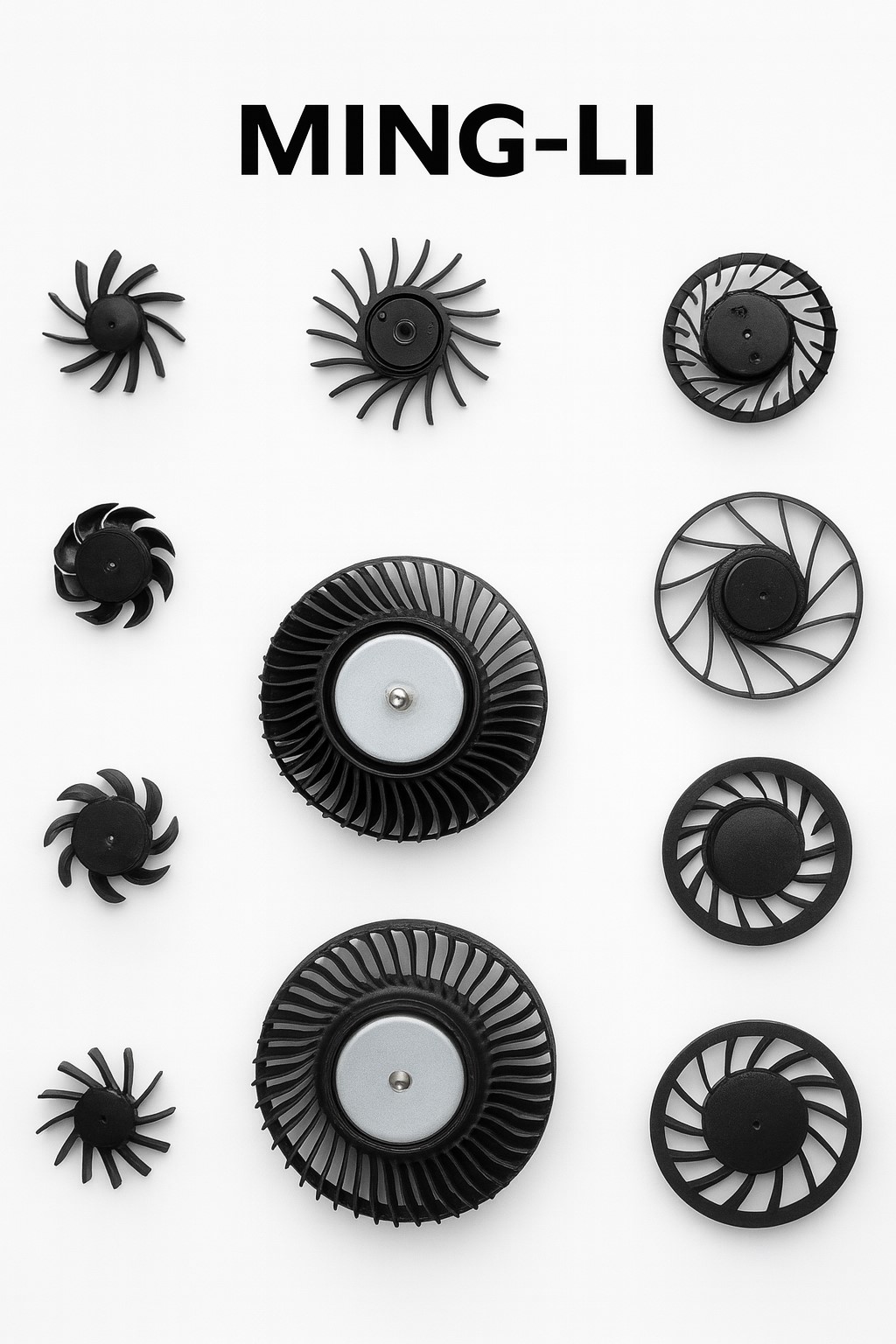
Injection-molding PEEK fans: what it takes to get repeatable results
Mold design for balance & warpage control
-
Gate strategy: balanced flow into the hub to minimize asymmetry; carefully placed submarine or valve gates to avoid knit lines across high-stress blade roots.
-
Venting & air traps: micro-vents at blade tips and between ribs to prevent gas marks that shift local mass.
-
Cooling layout: conformal or high-efficiency cooling near the hub and along the shroud; consistent cooling symmetry reduces differential shrinkage → better runout.
-
Parting line design: oriented away from critical aero edges; maintain polish/texture to avoid boundary-layer disturbances.
-
Insert interfaces: if overmolding a metal hub/shaft, use thermal isolation and mechanical interlocks to balance CTE mismatch.
Process window for PEEK
-
Melt/Tool temperatures: PEEK typically requires ~380–420 °C melt and high mold temperatures to achieve target crystallinity (grade-dependent).
-
Packing/holding control: sufficient to fill thin blades without over-packing hub; over-pack can induce hub ovality.
-
Cooling & crystallization management: controlled cool-down ramps or post-mold anneal to lock in geometry and reduce internal stress.
-
Moisture management: maintain material dryness; moisture can cause splay and property loss.
-
Fiber orientation (filled grades): if using CF- or GF-reinforced PEEK, gate/filling should direct orientation to support blade root strength and limit anisotropic warp.
Critical tolerances & inspection
-
Hub concentricity & flatness → low runout.
-
Blade thickness and chord tolerance → aero repeatability.
-
Tip-to-shroud gap → efficiency & tonal noise.
-
Mass symmetry → ISO 1940/1 balancing classes (application-specific).
-
Internal features (embedded hub, lattice cores) → 3D CT ensures integrity without destructive tests.
Quality & reliability verification (what OEMs expect)
-
Dynamic balancing: single- or two-plane balancing to application-specific grades; documentation traceable to serial/lot.
-
Thermal aging & heat soak: multi-temperature dwell with power cycling to capture creep/pitch shift.
-
Vibration & shock: random vibration profiles aligned to notebook/server standards; drop shock for mobile modules.
-
Endurance run: high-RPM life test (e.g., 1,000–5,000 h depending on class) with periodic CFM/acoustic checks.
-
Environmental exposure: humidity (e.g., 85 °C/85%RH), chemical splash, dust ingress.
-
CT scanning (ZEISS METROTOM 6): internal geometry, hub fit, wall-thickness mapping, porosity checks.
-
Dimensional audits: GR&R, Cpk on key measurands (tip gap, runout, blade thickness).
Application-specific guidance
1) Laptop cooling fans (ultra-thin)
Challenges: ultra-low Z-height, acoustic limits, intermittent turbo heat, strict power budgets.
PEEK value: thinner blades that hold pitch at temperature → maintain CFM @ low power, lower tonal noise via precise edge profiles, stable mass for low vibration.
Design tips:
-
Use swept trailing edges and a small leading-edge radius for broadband noise control; PEEK supports crisp edges.
-
Control tip clearance tightly; PEEK’s stability maintains efficiency over life.
-
Consider CF-reinforced PEEK for extra stiffness in <0.3 mm blade sections (balance flow-front carefully).
2) Smartphone micro-fans / active thermal modules
Challenges: extreme packaging, sensitive acoustics, rapid thermal spikes, strict mass limits.
PEEK value: excellent stiffness-at-heat for micro-blades, chemical resistance to adhesives/coolants, dimensional integrity for tiny tip gaps.
Design tips:
-
Optimize hub-to-blade fillet to reduce stress and creep.
-
Employ CT-verified micro ribs to tune flow without adding mass.
-
Specify mass-moment limits part-to-part for simpler balancing at assembly.
3) Server & data-center blowers
Challenges: high duty cycle, elevated inlet temps, redundancy requirements, acoustic targets for racks.
PEEK value: 24/7 reliability with low creep; stable air performance across thermal cycles; chemical resistance to dust-mitigation fluids/cleaners.
Design tips:
-
Design for two-plane balance tolerance; include manufacturing datum features for repeatable balancing.
-
Use post-mold anneal for geometry lock-in when ambient >60–80 °C.
-
Validate aero performance drift after 1,000 h at operating temperature.
DFM checklist for PEEK fan/impeller projects
-
Specify the duty profile: max RPM, continuous RPM, inlet temperature, acoustic target, life hours.
-
Define balance class & inspection gates: incoming, in-process, final; lot traceability.
-
Choose grade early: unfilled vs GF/CF-filled PEEK; consider color/UL needs.
-
Gate selection & flow simulation: avoid weld lines at blade roots; ensure complete fill in thin sections.
-
Cooling symmetry in mold: conformal or optimized circuits; resist hub ovality.
-
Crystallinity strategy: mold temp & cycle vs post-mold anneal; measure shrinkage on T1/T2.
-
Warpage management: tooling compensation + process window; validate on metrology + CT.
-
Acoustic geometry fidelity: micro-edge radii and surface finish controls; texture standards.
-
Balance features: datum for balancing; mass-trim allowance zones if required.
-
Reliability plan: thermal aging, vibration, life test, chemical exposure matrix.
Ming-Li Precision: what makes our PEEK fan programs succeed
Ultra-precision tooling & machining
-
±1 µm class capability with YASDA ultra-precision milling for critical mold inserts.
-
+GF+ AgieCharmilles EDM/wire-cut for fine ribs and thin-wall features.
-
OKAMOTO CNC grinding and SCHAUBLIN turning/grinding for concentric running fits.
-
Tooling designed with balanced cooling and warpage compensation for PEEK crystallinity control.
High-temperature injection molding expertise
-
Stable processing of PEEK at ~380–420 °C melt; mold temperature control to hit crystallinity targets.
-
Over 100 tons of PEEK production experience across industrial, automotive, and electronics parts.
-
Warpage & internal-stress control: optimized packing/cooling, anneal protocols where appropriate.
-
Thin-wall capability: sub-0.4 mm sections achievable with grade-appropriate gating and venting.
Inspection & validation
-
ZEISS METROTOM 6 CT for non-destructive internal verification: wall-thickness mapping, porosity, insert fit.
-
3D metrology for blade geometry, runout, hub concentricity.
-
Dynamic balancing capability aligned to customer class; documentation & serialization supported.
-
IATF 16949 quality management; PPAP documentation available for automotive-style workflows.
Engineering collaboration
-
Early DFM and mold-flow support (Autodesk Moldflow) to predict flow-front, weld lines, orientation.
-
Joint acoustic/performance tuning with customer thermal teams (fan curve, static pressure, tonal noise).
-
Rapid T-samples and parameter studies; data-driven iteration to hit aero & noise targets.
-
Ability to integrate metal hubs/shafts (overmolding) with CTE-aware designs and mechanical interlocks.
Design notes for high-speed stability (deep dive)
Blade root strength
-
The blade-to-hub junction sees maximum bending moments. Use elliptical fillets tuned by FEA; avoid weld lines across this region.
-
For filled PEEK, orient fibers along principal stress lines; valve-gating into the hub often helps.
Tip-gap control
-
Small tip gaps boost efficiency but demand tight runout. Compensate mold steel for shrinkage anisotropy; verify with CT and CMM.
-
Consider shroud features to reduce leakage without whistling tones.
Hub concentricity & shaft fit
-
Overmolded inserts must be concentric and stress-relieved. Manage thermal gradients at the insert to avoid frozen-in stress and ovality.
-
Use knurls, undercuts, or dovetail features rather than relying solely on adhesion.
Aero edge fidelity
-
Micro-radius (e.g., 0.03–0.08 mm) leading edges lower stall-related noise; trailing-edge serrations/sweeps spread tonal peaks. PEEK allows crisp replication with stable edges over life.
Typical project flow with Ming-Li Precision
-
Kick-off & requirements: RPM, temperature, acoustics, life, envelope.
-
Material & grade selection: unfilled vs GF/CF PEEK; color/UL roadmap.
-
Concept & DFM: gate plan, cooling, balance datum, tolerance stack.
-
Mold-flow & FEA loop: fill/pack/cool; stress & modal analyses for blades.
-
Tool build (ultra-precision): YASDA inserts, balanced cooling, polish/texture.
-
T0/T1 sampling: metrology + CT; establish process window.
-
Aero/acoustic tuning: iterate edge radii, sweep, chord minor edits.
-
Reliability testing: thermal aging, endurance run, vibration, chemistry.
-
PPAP/FAI & ramp: balancing SOP, SPC on critical features, packaging validation.
-
Mass production & support: continuous improvement, cost-down via cycle and yield.
Sourcing & cost considerations
-
Total cost of ownership (TCO): While PEEK resin is premium-priced, programs often reduce BOM risk by eliminating reinforcements, lowering scrap from warpage, extending service life, and avoiding field failures.
-
Cycle time vs crystallinity: Achieving target crystallinity may increase cycle; Ming-Li optimizes cooling and post-anneal to balance throughput and performance.
-
Yield: Precision tooling and CT-driven corrections typically reduce rework/balance time, improving effective yield.
-
Scalability: PEEK fans can be single-cavity during NPI and move to multi-cavity as acoustic/performance stabilizes; our automation (EROWA Robot Compact 80, AS/RS) supports efficient ramp.
Environmental & compliance notes
-
RoHS/REACH compatible grades available.
-
Flammability options (UL-related performance) are grade-dependent; we coordinate with material suppliers on color + UL needs.
-
Recyclability: PEEK regrind strategies must be validated for high-speed fans; we typically recommend virgin or controlled-regrind ratios for critical parts.
Recommended specifications to include in your RFQ
-
Operating profile: max/continuous RPM, ambient/inlet temp, duty cycle.
-
Performance targets: CFM/Pa at specific RPM, acoustic dBA & tonal limits.
-
Geometry controls: tip-gap, blade thickness range, runout spec, hub ID/OD.
-
Balance class: one- or two-plane, acceptance criteria.
-
Validation plan: CT scope, endurance hours, thermal aging conditions, vibration profile.
-
Packaging & handling: cleanliness class, ESD limits if near sensitive electronics.
-
Documentation: PPAP or equivalent, traceability requirements.
Image & diagram plan (placeholders you can fill later)
-
Hero banner (1200×630)
Alt: “High-speed PEEK cooling fan/impeller by Ming-Li Precision”
Content: Render or photograph of a thin PEEK impeller with callouts. -
Materials comparison chart
Alt: “PEEK vs PPS vs PA66 vs PC/ABS temperature & stiffness comparison”
Content: Bar/line graphic showing modulus retention vs temperature. -
Blade root FEA
Alt: “Stress distribution at blade-to-hub junction for high RPM”
Content: Pseudocolor stress plot; notes on fillet and fiber orientation. -
CT wall-thickness map
Alt: “ZEISS METROTOM 6 CT thickness map of molded PEEK fan”
Content: Rainbow thickness map demonstrating uniformity and tip-gap. -
Process window graphic
Alt: “PEEK molding window: melt/mold temperature vs crystallinity”
Content: Heatmap or phase window with recommended ranges. -
Application collage
Alt: “Laptop, smartphone, server thermal modules using PEEK fans”
Content: Three tiles showing notebook thermal stack, smartphone micro-module, server blower.
FAQ (SEO-friendly)
Q1: Why choose PEEK for laptop or smartphone fans instead of PPS or PA66?
PEEK maintains stiffness and dimensional accuracy at higher temperatures, resists creep over long duty cycles, and enables thinner, lighter blades—critical for high-RPM stability, low noise, and consistent airflow.
Q2: Can PEEK fans be balanced to low-noise targets for premium devices?
Yes. With precise molding and CT-verified geometry, fans can be dynamically balanced to demanding classes, reducing vibration and tonal spikes.
Q3: Is carbon-fiber reinforced PEEK necessary?
Not always. Unfilled PEEK often meets thin-wall needs; CF/GF grades may be chosen for extreme thinness or stiffness targets. We evaluate flow, orientation, and warpage trade-offs during DFM.
Q4: What is the typical processing temperature for PEEK?
Melt ~380–420 °C with elevated mold temperature to achieve desired crystallinity; exact settings are grade- and geometry-dependent.
Q5: Can Ming-Li provide PPAP and automotive-style validation?
Yes. Ming-Li operates under IATF 16949 and can provide PPAP-level documentation, CT reports, and life-test data.
About Ming-Li Precision
Ming-Li Precision is a Taichung-based ultra-precision moldmaker and injection molder specializing in high-performance polymers and insert/overmolding for demanding applications. Capabilities include:
-
Ultra-precision tooling: YASDA milling (±1 µm class), +GF+ AgieCharmilles EDM/wire-cut, OKAMOTO grinding.
-
Automation: EROWA Robot Compact 80, Genius AS/RS for tooling and production efficiency.
-
High-temperature molding: Proven PEEK processing, thin-wall fan/impeller programs.
-
Metrology & CT: ZEISS METROTOM 6 for non-destructive 3D inspection and GD&T verification.
-
Quality: IATF 16949; data-driven SPC on critical dimensions.
-
Experience: 100+ tons of PEEK molded across electronics, automotive, and industrial sectors.
Call to action
Ready to upgrade your thermal module with high-speed, high-reliability PEEK fans?
-
Request DFM & feasibility: Send 3D (STEP/Parasolid), performance targets, and duty profile.
-
Ask for a sample plan: We can propose gate/cooling strategy, balance class, and validation matrix.
-
Collaborate early: Our engineering team will help lock geometry for aero + acoustic + manufacturability from day one.
Contact Ming-Li Precision to launch your PEEK fan program: karl@mingli-molds.com.tw (or your usual contact).
Let’s build quieter, cooler, and more reliable devices—from laptops and smartphones to AI servers—with the material and process that make high-RPM stability real: PEEK.